Timing of surgery in acute cholecystitis
Early surgery is now the default for most patients with acute cholecystitis. The hard decisions are at the edges: the frail, the septic and the patient who presents late.
Reviewed against its sources on 3 November 2026.
- Early laparoscopic cholecystectomy on the index admission is the default for Tokyo grade I and II cholecystitis.
- There is no 72-hour cliff: fitness, not the calendar, decides.
- Assess severity and fitness separately. Operable high-risk patients may benefit from surgery; selected grade III cases need an advanced centre, and others may need drainage.
01Diagnosing and grading acute cholecystitis
Tokyo Guidelines 2018 (TG18): suspected = one of A plus one of B; definite = A plus B plus C.
| Grade | Criteria | 30-day mortality |
|---|---|---|
| III severe | Any one organ dysfunction: cardiovascular (dopamine ≥5 µg/kg/min or any noradrenaline), neurological, respiratory (PaO₂/FiO₂ below 300), renal (oliguria or creatinine above 2.0 mg/dL), hepatic (INR above 1.5), haematological (platelets below 100,000/mm³) | 5 to 10% |
| II moderate | Any one of: white cells above 18,000/mm³; palpable tender RUQ mass; symptoms over 72 hours; marked local inflammation (gangrene, emphysema, abscess, biliary peritonitis) | About 1% |
| I mild | Healthy patient, no organ dysfunction, mild inflammatory change | About 1% |
More detail and sources
The Tokyo Guidelines 2018 are the standard for diagnosis and severity grading, and most trials and other guidelines use them (Yokoe et al., J Hepatobiliary Pancreat Sci 2018). Guideline Mortality figures are from the Japanese and Taiwanese cohorts used to derive TG18 and vary with the population. The American Association for the Surgery of Trauma (AAST) grades anatomical severity instead (grade I acute cholecystitis; II empyema, gangrene or emphysema; III perforation with local contamination; IV perforation with abscess or fistula; V perforation with generalised peritonitis), which correlates better with operative difficulty than the Tokyo grade (Madni et al., J Trauma Acute Care Surg 2019). The 2020 multi-society consensus suggests using TG18, AAST or another validated system. Guideline
02Early versus delayed surgery
- “Cool it and come back in six weeks” has been reversed by trials and registries. Operate on the same admission.
- Targets: within 7 days of admission and 10 days of symptom onset (WSES); within one week of diagnosis, else after four weeks (NICE QS104).
- There is no 72-hour cliff edge. Earlier is easier; later on the same admission still beats delay, at the price of more conversions and subtotals.
Trials, guidelines and the 72-hour question
- The Cochrane review of six randomised trials (488 patients) found no difference in bile duct injury or serious complications between early laparoscopic cholecystectomy (within 7 days of presentation) and delayed surgery (after 6 weeks). Early surgery shortened the total hospital stay by about 4 days, and about 18 percent of delayed patients needed an urgent operation while waiting (Gurusamy et al., Cochrane 2013).
- The German ACDC trial randomised 618 patients to cholecystectomy within 24 hours of admission or to antibiotics and surgery at 7 to 45 days. Morbidity at 75 days was 11.8 percent with immediate surgery and 34.4 percent with delayed treatment, with shorter stay and lower cost in the early group (Gutt et al., Ann Surg 2013).
- NICE Quality Standard 104 requires laparoscopic cholecystectomy within one week of diagnosis, or, if this cannot be done, after the episode has settled, more than four weeks later (NICE QS104). Guideline
- WSES 2020 strongly recommends early laparoscopic cholecystectomy as soon as possible: within 7 days of admission and within 10 days of symptom onset, provided the surgeon is experienced. It recommends delaying beyond 6 weeks only when early surgery is not possible (Pisano et al., WSES 2020). Guideline
The 72-hour question. Operating within 72 hours of symptom onset is easier, and the 2020 multi-society consensus gives a conditional recommendation for surgery within 72 hours for mild disease (Brunt et al., Ann Surg 2020). Patients presenting later than 72 hours still do better with surgery on the same admission than with delayed surgery, with higher conversion and subtotal rates as the price. The consensus made no recommendation on timing for moderate or severe disease because the evidence was insufficient. Contested Whether surgery remains safe beyond 7 to 10 days of symptoms is genuinely uncertain: observational data suggest higher conversion and complication rates. Operate early where possible, accept that day 8 to 10 will be harder, and keep a low threshold for bail-out in the late presenter.
Confirm diagnosis; stabilise and grade severity
Fluids, analgesia, antibiotics and organ support as needed. Assess comorbidity, anaesthetic risk and local expertise.
Choose the severity branch
Grade I · Mild disease
Early lap chole if CCI ≤5 and ASA-PS ≤2. Otherwise: medical treatment; surgery when fit.
Grade II · Moderate disease
Early lap chole if CCI ≤5 and ASA-PS ≤2, with an experienced surgeon. Otherwise: medical treatment and/or drainage, then delayed surgery after improvement.
Grade III · Organ dysfunction
Early surgery only at an advanced centre: CCI ≤3, ASA-PS ≤2; rapidly reversible cardiovascular or renal failure; no negative predictive factors. Otherwise: stabilise, urgent/early drainage and reassess for delayed surgery.
Grade III: negative predictive factors
Bilirubin ≥2 mg/dL, neurological dysfunction or respiratory dysfunction. “Favourable” organ failure means cardiovascular or renal dysfunction that rapidly reverses after initial treatment.
WSES 2020: distinguish high risk from being unfit
Early surgery remains preferred in suitable patients, including many at high risk. Gallbladder drainage is for patients who are not suitable for surgery. Timing is individualised to condition and resources.
CCI: Charlson Comorbidity Index. ASA-PS: American Society of Anesthesiologists physical status.
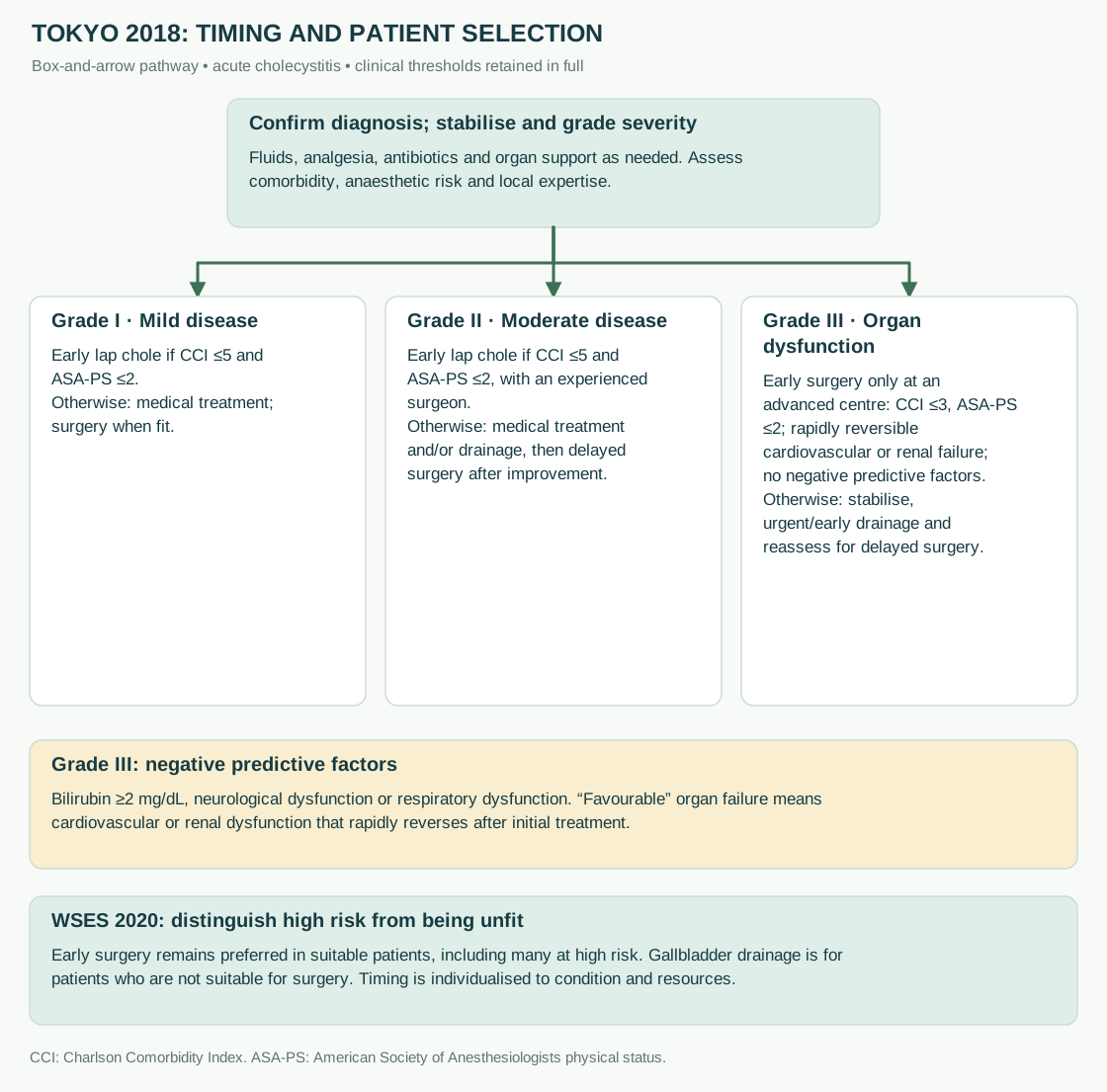
Diagram sources
03The Tokyo 2018 flowchart
The decision depends on grade, reserve (Charlson Comorbidity Index, CCI; ASA class) and the centre.
| Grade | Early lap chole if | Otherwise |
|---|---|---|
| I | CCI ≤ 5 and ASA ≤ 2 | Antibiotics and support, then elective surgery when fit |
| II | CCI ≤ 5, ASA ≤ 2 and an experienced surgeon | Medical treatment and/or gallbladder drainage; delayed surgery after improvement |
| III | Advanced centre only; “favourable” organ failure (cardiovascular or renal, quickly reversible); no jaundice, neurological or respiratory failure; CCI ≤ 3 and ASA ≤ 2 | Urgent biliary drainage, usually percutaneous; delayed cholecystectomy after recovery |
Sources
Flowchart: Okamoto et al., 2018. Guideline TG18 also lists the safe steps for the operation and the bail-out options when the Critical View of Safety cannot be obtained (Wakabayashi et al., 2018). The Delphi work behind TG18 identified 25 intra-operative findings that define difficulty, described on the difficulty page.
04Who should have a cholecystostomy instead?
- Drainage turns a septic patient into a non-septic one. It is not a cure: about a third have recurrent biliary events after the tube comes out, and tube complications are common.
- CHOCOLATE put surgery first even in high-risk patients (APACHE II 7 to 14) who can tolerate it. WSES: strong recommendation, high-quality evidence.
- It excluded APACHE II above 14, so the sickest patients are judged by TG18 and clinical sense.
- General anaesthesia is unacceptable (severe cardiorespiratory disease, very high ASA, moribund).
- Grade III with organ failure that is not rapidly reversible, or with jaundice, neurological or respiratory failure.
- Anticoagulation cannot be reversed in time.
- The patient declines surgery.
- Drain a fit patient because the gallbladder “looks hot”.
- Assume the tube has solved the problem: plan the interval cholecystectomy, usually at 6 to 8 weeks, with an experienced surgeon.
- Expect the interval operation to be easy: conversion and subtotal rates are higher.
More detail and sources
The CHOCOLATE trial randomised 142 high-risk patients (APACHE II score 7 to 14) with acute calculous cholecystitis to laparoscopic cholecystectomy or percutaneous drainage. Major complications occurred in 12 percent of the surgery group and 65 percent of the drainage group. Reintervention was needed in 12 percent versus 66 percent, and recurrent biliary disease occurred in 5 percent versus 53 percent. The trial was stopped early for benefit (Loozen et al., BMJ 2018). WSES recommends laparoscopic cholecystectomy over percutaneous drainage in operable high-risk patients (strong recommendation, high-quality evidence). TG18 uses a different, grade-specific pathway incorporating CCI, ASA-PS, organ dysfunction and advanced-centre expertise; it should not be described as the same recommendation. See the TG18 criteria above. CHOCOLATE should not be extrapolated to patients too unstable or unfit to meet its selection criteria. Guideline
Endoscopic drainage (transpapillary stenting, or endoscopic-ultrasound-guided drainage with a lumen-apposing metal stent) is an alternative in centres with the expertise. WSES suggests it may be preferred to percutaneous drainage where available (Pisano et al., WSES 2020; Mori et al., TG18 drainage). Contested Long-term data and the question of later cholecystectomy through a stented gallbladder are unresolved.
After a cholecystostomy. If the patient recovers and is fit, interval cholecystectomy is suggested, usually at 6 to 8 weeks (some units operate earlier). The tube is kept until then or until a tube cholangiogram shows a patent cystic duct. In patients who remain unfit, the tube can be removed after a cholangiogram shows a patent cystic duct and no stones, accepting a risk of recurrence. The 2020 multi-society consensus suggests interval cholecystectomy for fit patients and non-surgical management for unfit patients. Guideline
05The late presenter and the recurrent attack
- After 10 days of symptoms with a mass or abscess there is no trial evidence.
- Options: drain the abscess and operate on the same admission if fit; or antibiotics and drainage, then surgery at 6 weeks.
- Whatever is chosen, the patient leaves with a date for surgery: readmission with another attack while waiting is around 20 to 30 percent.
06What the registries say
Age, ASA class, setting (elective, delayed or emergency), approach and Nassar difficulty grade were the main predictors of complications. Early surgery in the elderly is still favoured by WSES, but plan, consent and staff it as the higher-risk operation it is.
Sources
AMBROSE prospective cohort: AMBROSE Collaborative, Ann Surg 2025. Systematic review of 99 studies and 326,517 patients: mortality after laparoscopic cholecystectomy about seven times higher in the elderly, with roughly twice the complication and conversion rates (Kamarajah et al., Surg Endosc 2020).
Test yourself further: Practise questions on Timing in acute cholecystitis in the Exam zone.