The Critical View of Safety
The CVS is a method of identification, not a view. Most bile duct injuries happen to surgeons who believed they had it.
Reviewed against its sources on 3 November 2026.
- Three criteria, all required: triangle cleared, lower third of the gallbladder off the cystic plate, only two structures entering.
- It is identification by exclusion at the gallbladder end, never a dissection towards the common duct.
- Prove it from both sides, pause before clipping, record it; if it will not come, image or bail out.
01What the Critical View of Safety is
- Hepatocystic triangle cleared of fat and fibrous tissue. The common and common hepatic ducts need not be seen, and should not be dissected.
- Lower third of the gallbladder off the liver, so the cystic plate is exposed.
- Two, and only two, structures enter the gallbladder.
Identification by exclusion. Once the triangle is empty and the lower gallbladder is off the liver, the only two tubes that still end in the gallbladder must be the cystic duct and artery. Every other structure continues past it.
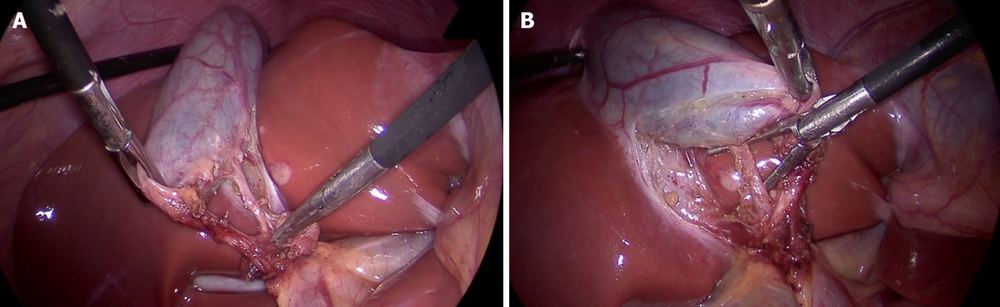
Image source and reuse
More detail and sources
Strasberg, Hertl and Soper described the Critical View of Safety in 1995 as a method of conclusively identifying the cystic duct and cystic artery before they are divided (Strasberg et al., J Am Coll Surg 1995); the three requirements are set out in Strasberg and Brunt, J Am Coll Surg 2010. The 2020 multi-society consensus and the WSES and Tokyo guidelines all recommend it as the standard method of identification. Guideline No trial has compared it with other methods, and it is unlikely one ever will.
Gupta’s 2023 How-I-Do-It technical article summarises published evidence and practice: the CVS is endorsed by the major guidelines cited here and in routine practice can be obtained in about 85 to 95 percent of operations (Gupta, Ann Hepatobiliary Pancreat Surg 2023). Contested The same article quotes the multi-society guideline’s pooled comparison of bile duct injury rates with the CVS and with the infundibular technique; those pooled figures come from heterogeneous observational series and should not be read as a trial result.
02What it is not
Not a view
It is the result of a dissection, not something seen at a glance. Two tubes with some fat cleared between them is not a CVS unless the cystic plate is exposed behind them.
Not the infundibular technique
Seeing the duct “flare” into the infundibulum fails when inflammation sticks the neck to the common duct: the false infundibulum.
Every injury in Strasberg’s 2000 review occurred when the duct was isolated and divided first
Not seeing the common duct
Dissecting to the junction “to confirm” causes bleeding, thermal injury and devascularisation. It is a cause of injury, not a safeguard.
Not cholangiography
Imaging is an adjunct for when the CVS cannot be obtained or the picture does not add up. A cholangiogram through a divided duct is a diagnosis, not a prevention, though it still limits the damage: it shows the injury before more is clipped or burnt.
Not two windows
Two holes in the fat showing a short length of duct and artery, without clearing the triangle or exposing the plate, is not a CVS, however convincing the photograph.
Not always achievable
In severe inflammation the honest statement is “CVS not achievable” and the operation becomes a bail-out. Forcing a view through fibrosis is how experienced hands injure.
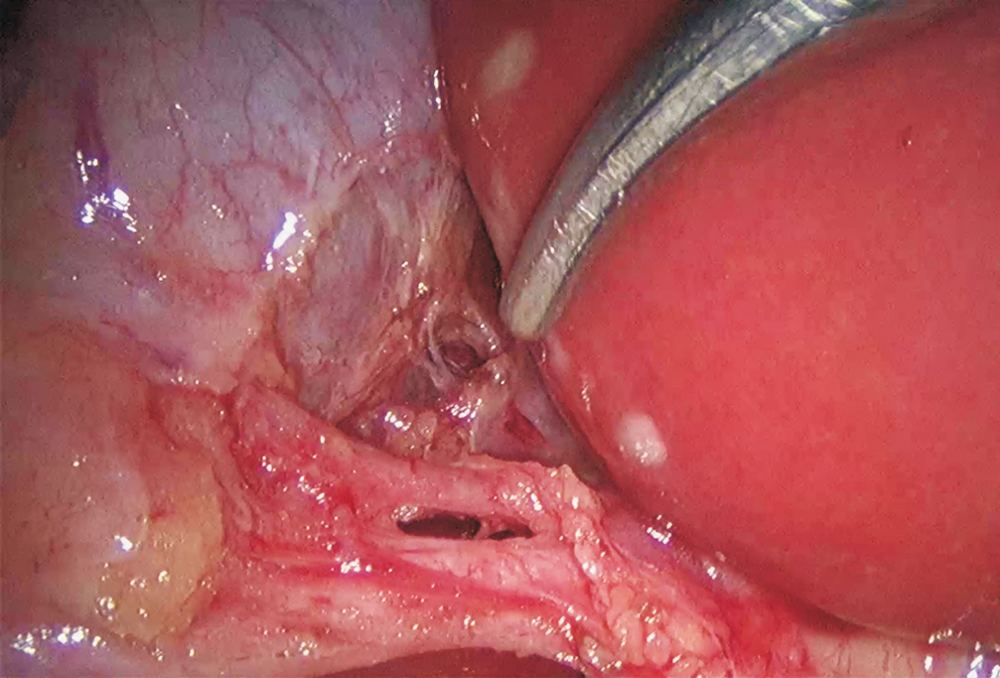
Image source and reuse
Sources
Infundibular technique failures: Strasberg et al., J Am Coll Surg 2000. Two windows: Gupta, Ann Hepatobiliary Pancreat Surg 2023.
03The doublet view and how to document it
- The CVS is three-dimensional; one photograph does not prove it. Take two images before clipping: the anterior face, and the posterior face with the neck flipped medially.
- Sanford and Strasberg’s score: each criterion 0 to 2 per view, maximum 6; 5 or more per view is satisfactory.
- The posterior view is not a formality: the deep cystic artery, a second artery or a sectoral duct hiding behind the first structure is found there or not at all.
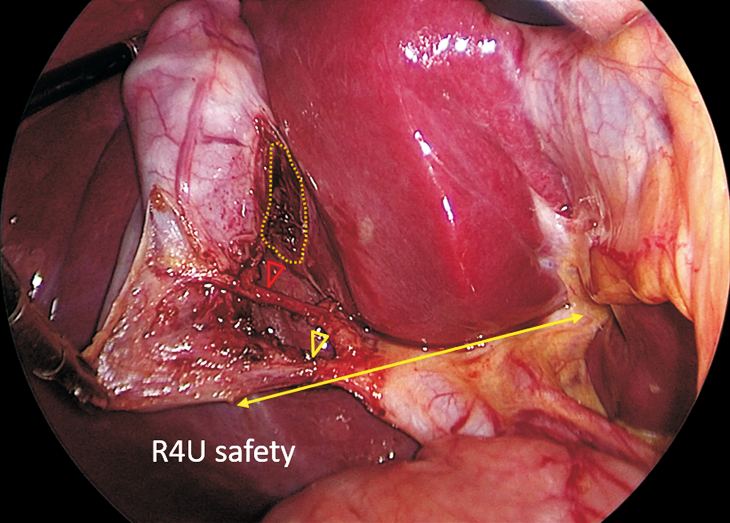
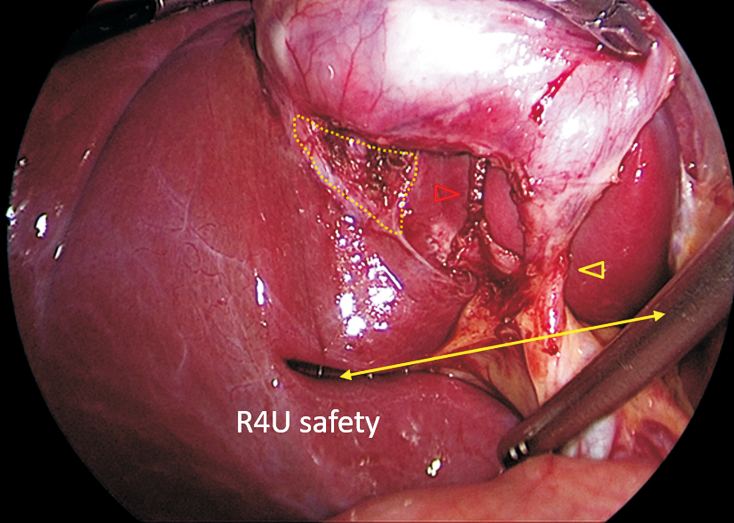
Image source and reuse
Reproduced from Gupta V. How to achieve the critical view of safety for safe laparoscopic cholecystectomy: Technical aspects. Ann Hepatobiliary Pancreat Surg 2023;27(2):201-210, Fig. 8B (doi:10.14701/ahbps.22-064), under the CC BY-NC 4.0 licence. No changes other than resizing.
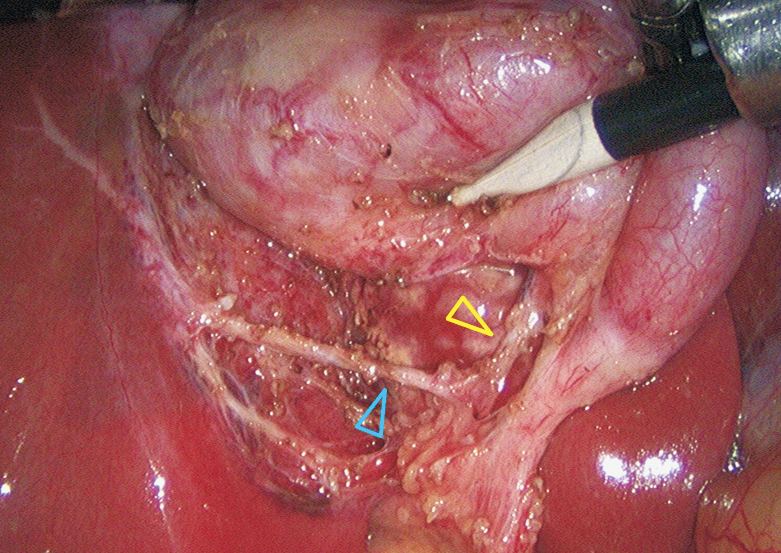
Image source and reuse
- Capture both views with the clips not yet applied; a third after clipping if you wish.
- Store the images in the patient record, not only on the stack.
- Describe the three criteria in words in the note.
- If the CVS was not achieved, say so and say what was done instead.
- Write “CVS achieved” as the whole description.
- Submit two anterior shots as a doublet.
- Photograph after the clip and call it proof.
More detail and sources
The doublet view and scoring sheet are from Sanford and Strasberg, J Am Coll Surg 2014; when they applied the score to their own photographs, well-trained surgeons achieved a satisfactory doublet in the great majority of elective cases. Observational The 2020 consensus made no recommendation on CVS documentation because of panel disagreement and feasibility, acceptability and medicolegal concerns. Doublet photographs or video remain useful for teaching and quality assurance; neither is a mandatory minimum under that guideline. The deep (posterior) branch of the cystic artery and its junction with the anterior branch are often visible only when the gallbladder is flipped to the left (Gupta, Ann Hepatobiliary Pancreat Surg 2023).
Watch the official operative video accompanying Gupta 2023. YouTube may require sign-in for this age-restricted surgical video. Video context and source.
04The pause before clipping
The SAGES Intra-operative Momentary Pause: before any ductal structure is clipped or cut, the surgeon states that the CVS has been obtained and invites the team to confirm. It converts a private belief into a public claim that can be contradicted, as “challenge and response” does in aviation. The assistant and scrub nurse should know the three criteria and be expected to speak if they cannot see them. Expert opinion See culture of safety.
Source
SAGES Safe Cholecystectomy Program. The 2020 consensus frames the pause as expert-opinion best practice.
05How surgeons wrongly believe they have the CVS
| The belief | What happened | Safer next action |
|---|---|---|
| “I cleared the fat between the two structures.” | A window, not an empty triangle; above and behind never cleared | Clear from the gallbladder wall up to the liver edge, then turn the gallbladder and look behind |
| “I can see the duct going into the gallbladder.” | Neck fused to the common duct; the “cystic duct” was the common duct (hidden cystic duct) | Take the lower third off the plate first; if the neck will not free, think bail-out |
| “I followed the duct to the junction.” | Heat and traction on the common duct; the junction may have been an aberrant duct | Identify at the gallbladder end by exclusion; image if the junction is in doubt |
| “There were two structures.” | Two in the plane looked at; a sectoral duct or posterior artery ran behind | Two structures in both views, liver visible through the triangle; explain any third structure before clipping |
| “I have two pictures, so I have a doublet.” | Two anterior shots; posterior relationships never seen | Retract the neck to the umbilicus, look from behind, record what could and could not be seen |
| “The CVS was obtained” (written afterwards) | Recall bias: written from the belief, not the image | Photograph the doublet before the first clip; nothing to photograph means no CVS |
| “I have done a thousand of these.” | Experience without a method; most injuries are by confident, experienced surgeons | Apply the method and the pause in every case; invite the assistant to disagree |
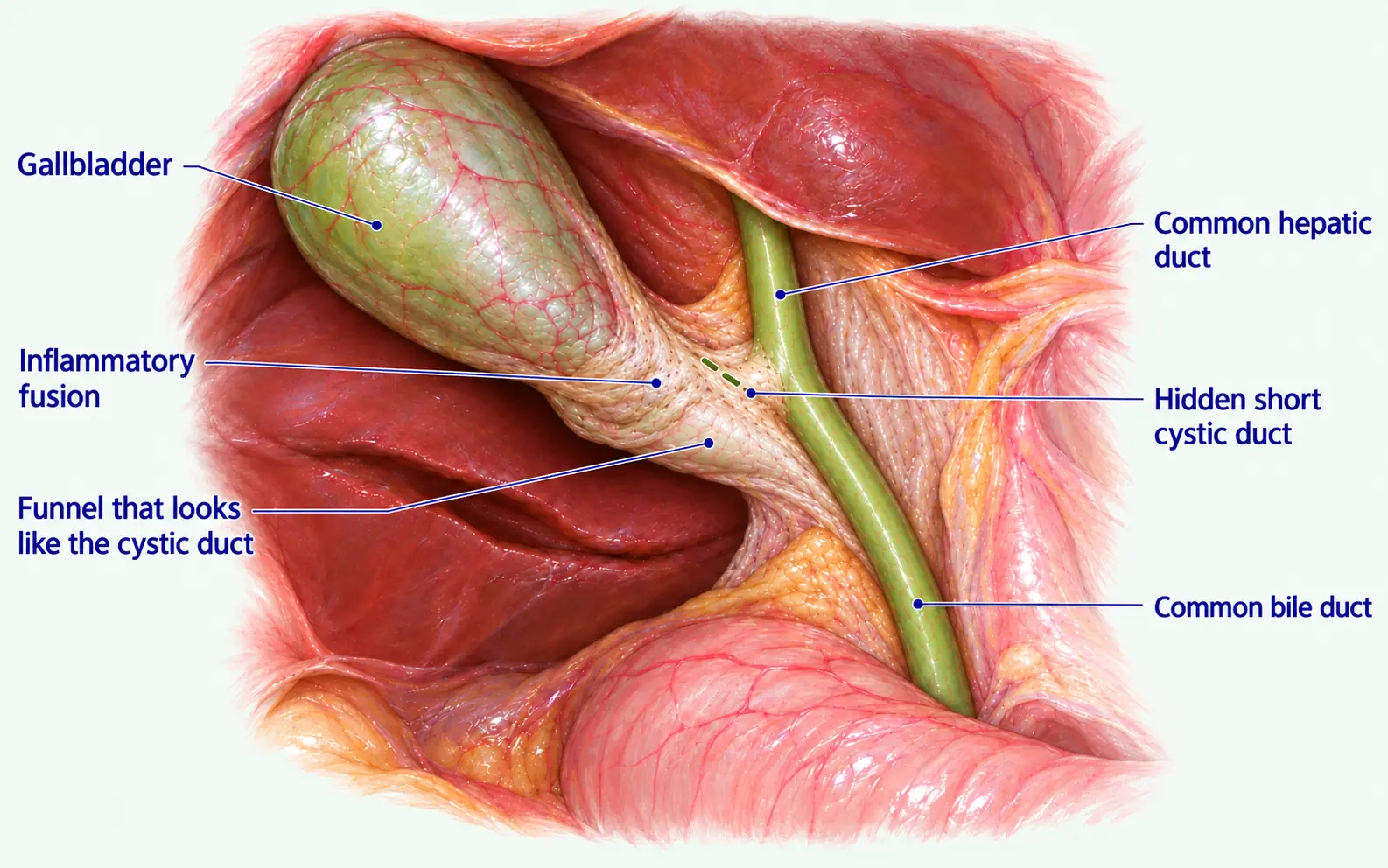
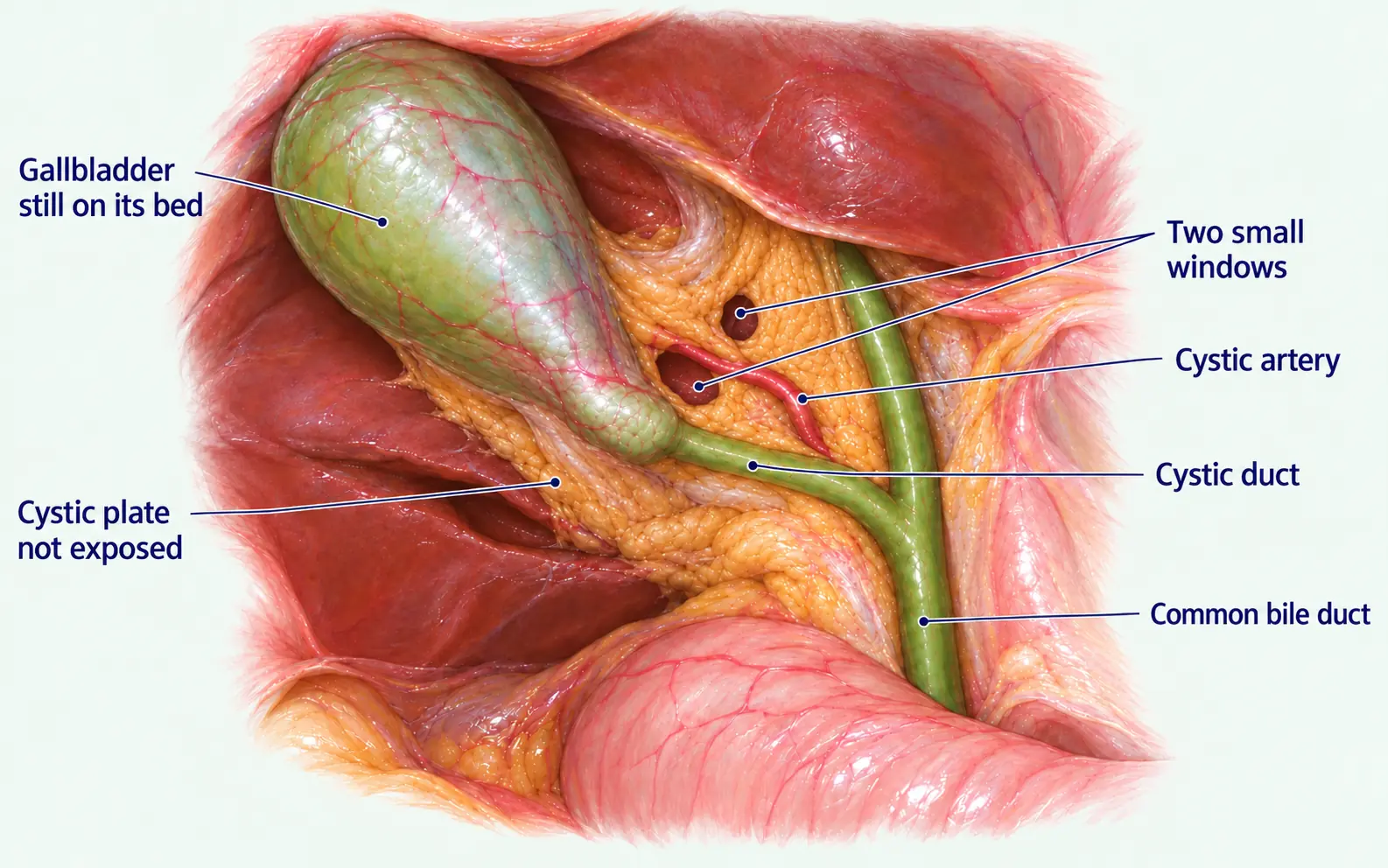
Image source and reuse
Sources
In a Brazilian survey of 446 surgeons, only 22 percent could correctly identify the three elements of the CVS, and surgeons who misidentified the elements reported more bile duct injuries (Castro et al., ABCD 2018). Video studies in which experts scored recorded operations have found the CVS fully achieved in far fewer cases than surgeons report, often under half. Contested Reported achievement rates range from under 20 percent to over 90 percent depending on who is scoring and how strictly.
06Why the CVS fails: the “fundamental” error
The surgeon sees the common duct and perceives it as the cystic duct; confirmation bias then makes every later finding fit. The CVS does not ask you to recognise the cystic duct. It asks you to prove nothing else is there. The pause and a second pair of eyes defend against the bias that follows the illusion.
Source
Way et al., Ann Surg 2003; the percentages are those reported by the authors and were not re-verified against the full text for this site.
07Artificial intelligence and the CVS
- Deep-learning models can score the three criteria and segment “go” and “no-go” zones in real time, approaching expert raters.
- A randomised trial of real-time AI guidance has been registered (NCT07186803, Toronto, 64 patients); no results had been published when this page was reviewed.
- Contested No evidence yet that AI feedback reduces injuries: a research tool and a promising teaching aid, nothing more.
Sources
Mascagni et al., Ann Surg 2022; Madani et al., Ann Surg 2022; ClinicalTrials.gov NCT07186803.
- CVS anteriorSAGES, a brief video of the anterior view of the dissection.
- CVS posteriorSAGES, the same dissection seen from behind: the second half of the doublet view.
- The SAGES Safe Cholecystectomy ProgramThe six strategies, the doublet view and the didactic modules (the modules need a SAGES account).
Links checked 25 October 2026.
08What examiners ask
- State the three criteria exactly, and which triangle they refer to.
- Why the common bile duct does not need to be seen.
- Describe the doublet view and how you document the CVS.
- CVS versus the infundibular technique, and why the latter fails in inflammation.
- What you do when the CVS cannot be obtained (bail-out page).
Test yourself further: Practise questions on Critical View of Safety in the Exam zone.