Bail-out strategies when the CVS cannot be achieved
Deciding not to finish a cholecystectomy is a skill. The surgeons who get hurt are the ones who keep going.
Reviewed against its sources on 3 November 2026. Open checks: long-term subtotal figures are taken from the 2023 overview, not from each primary paper.
- Stop when the triangle will not clear from the gallbladder, a structure cannot be named, or 30 minutes have changed nothing.
- Get help and clarify the anatomy. If it remains unclear, favour subtotal; convert or stop when needed. Bail-outs are options, not a fixed sequence.
- Fenestrating leaks more early, reconstituting has more remnant trouble later; both beat a bile duct injury.
01The stop rule
- Define the zone of risk before you start: the hepatoduodenal ligament below the R4U line and medial to the gallbladder neck. Dissection there is dissection on the bile duct and the hepatic artery.
- Stop when the triangle cannot be cleared by staying on the gallbladder, the neck will not move, a structure you cannot name appears, or there has been no progress for a set time. Stop means hands off, no clips, no diathermy, say out loud what is happening.
- Change the operation in a planned order: get help, image the ducts, then choose a bail-out. The choice is not failure.
Orientate and assess difficulty
Identify fixed landmarks; optimise exposure, decompress if needed and assess progress.
Can all three CVS criteria be achieved safely?
Yes
Confirm CVS, pause, document
Use anterior and posterior views. Once identification is secure, clip, divide and complete.
No / progress stalls
STOP and obtain help
No clips on an uncertain structure. Ask an experienced colleague; use IOC when anatomy is uncertain or injury is suspected. ICG is an adjunct.
After STOP and reassessment / imaging, is the anatomy still undefined?
No
Choose an approach with a safe plane
Fundus-first total dissection is considered only when anatomy is defined and the plane is safe. Stop if the plane is lost.
Yes
Prefer subtotal over total fundus-first
When CVS cannot be obtained and anatomy remains undefined, consider subtotal cholecystectomy if it can be performed safely.
Conversion is one safety option
Convert when it improves access or control. Conversion alone does not resolve distorted anatomy.
Still unsafe? Stop or abort
Use drainage or cholecystostomy when appropriate; control infection and arrange specialist care. Document the reason and explain it to the patient.
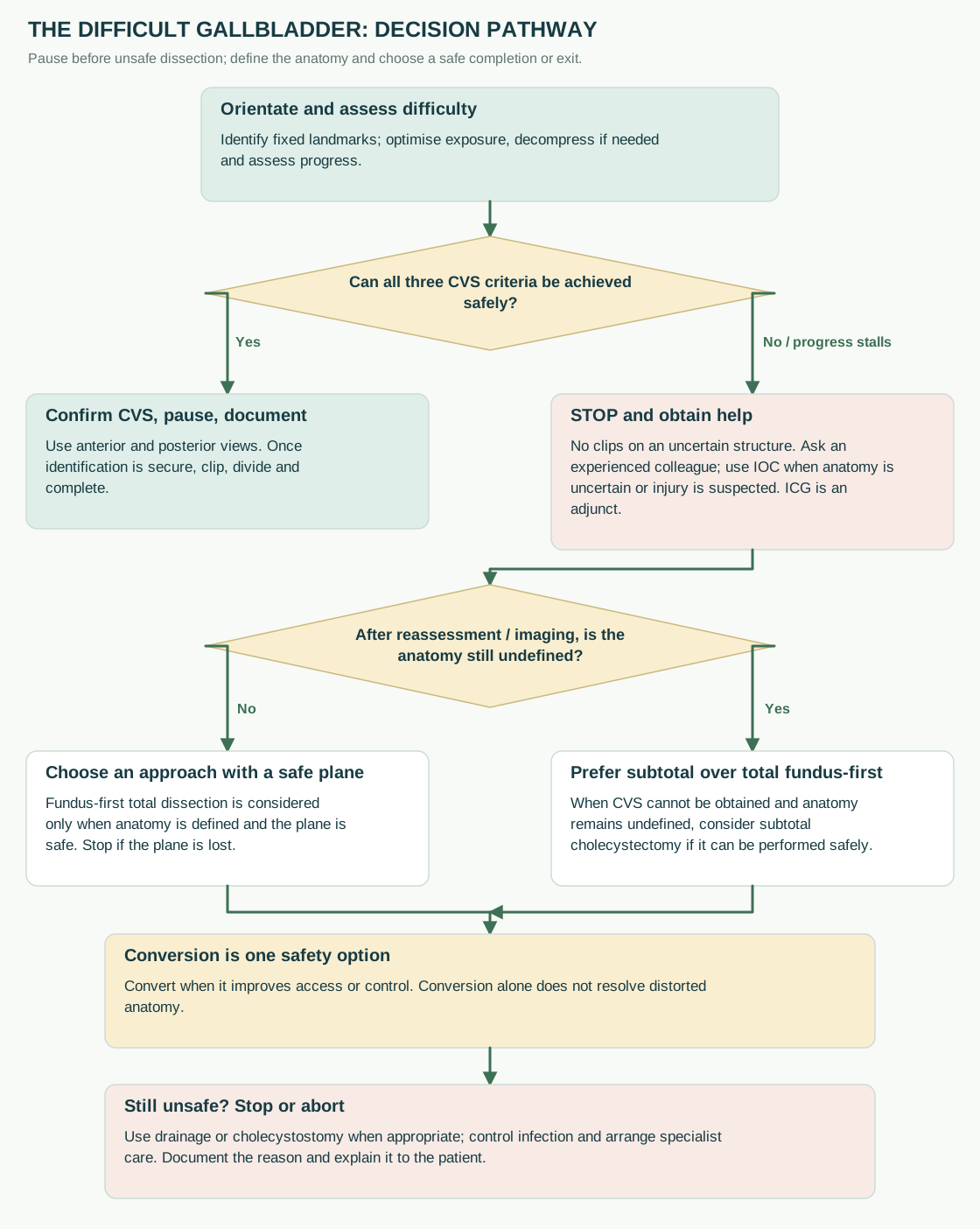
Diagram sources
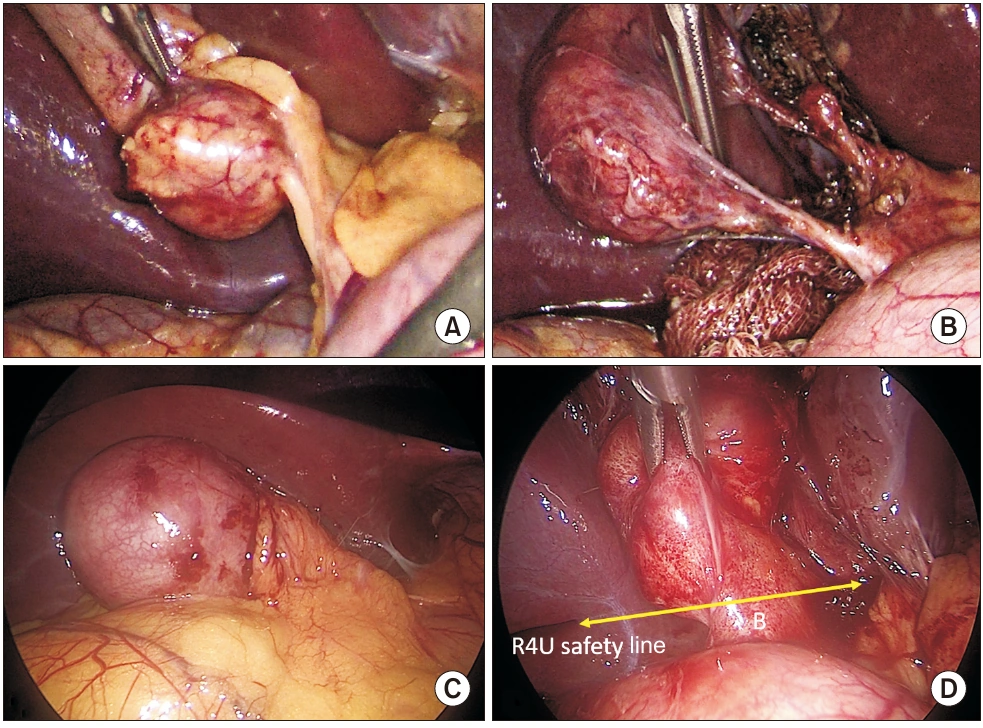
Image source and reuse
Sources
The fifth strategy of the SAGES Safe Cholecystectomy Program is to “recognize when the dissection is approaching a zone of significant risk and halt the dissection before entering the zone”, and to “finish the operation by a safe method other than cholecystectomy if conditions around the gallbladder are too dangerous” (SAGES). Guideline The 2020 multi-society consensus, Tokyo 2018 and WSES 2020 all recommend bail-out procedures when the Critical View of Safety cannot be achieved. Guideline
02First: help and imaging
Call a second surgeon
The consensus recommends it when practical. A fresh pair of eyes often sees the plane, or the mistake.
Image the ducts
When anatomy is uncertain or bile duct injury is suspected, stop and obtain biliary imaging, particularly intraoperative cholangiography (IOC), using a safe access route.
Indocyanine green (ICG) fluorescence can help you orient yourself. Do not treat it as a substitute for IOC when injury is suspected, or for careful dissection and anatomical identification. See the imaging page for the newer guidance.
Getting the picture must not need an unsafe cut: never incise or cannulate a structure you cannot name. If no safe route exists, get help and choose a bail-out
Source
Brunt et al., 2020: when the anatomy is uncertain or an injury is suspected, the consensus recommends intra-operative biliary imaging, in particular cholangiography (strong recommendation, very low certainty), and suggests a low threshold for calling another surgeon (conditional). It recommends imaging; it does not say that every route to the ducts is safe. The access route must be selected according to the operative findings and expertise; it must not require unsafe dissection or cannulation of an unidentified structure. The adjunctive role of near-infrared fluorescence is addressed separately in question 5B (conditional recommendation, very low certainty). Guideline Expert opinion
03Fundus-first (top-down) dissection
- The triangle is hidden by adhesions or fat but the plane between gallbladder and cystic plate is clear: the chronically scarred, not acutely inflamed, gallbladder.
- Dissecting from above delivers the neck into view; the cystic duct is then identified in the usual way, with the three CVS criteria still applied.
- Severe acute or contractive inflammation. The cystic plate thickens and shortens, so a dissection that thinks it is on the gallbladder wall is in the hilum, among the right portal pedicle.
- Most of Strasberg and Gouma’s eight “extreme” vasculobiliary injuries (four deaths, one transplant) followed fundus-down dissection in a severely inflamed gallbladder, usually after conversion.
If CVS cannot be achieved and other methods have not clarified the biliary anatomy, consider subtotal rather than fundus-first total cholecystectomy. Fundus-first is reasonable only while the plane is obvious. The moment it is lost, stop and change to a subtotal.
Source
Strasberg and Gouma, HPB 2012. Eight-patient case series The subtotal preference in the 2020 multi-society guideline (Q2) applies when CVS and anatomy remain unresolved; it is expert opinion, without direct comparative evidence.
04Subtotal cholecystectomy
Remove the free wall and the stones. Leave what is dangerous to dissect: the back wall on the liver and the neck in the inflamed triangle. The bile duct is never approached. Strasberg standardised the two types in 2016.
Fenestrating
Open the gallbladder, remove stones, excise the free wall, ablate the mucosa of the back wall, close the cystic duct orifice from inside with a purse-string if it can be seen. The remnant is left open.
No closed remnant to grow new stones, but retained stones and later biliary events still happen. Bile can leak from the orifice until it seals
Reconstituting
Close the remnant neck with sutures or a stapler, leaving a small closed pouch.
Fewer early leaks than the fenestrating type, but the pouch is a miniature gallbladder: new stones, recurrent cholecystitis and completion surgery years later in some
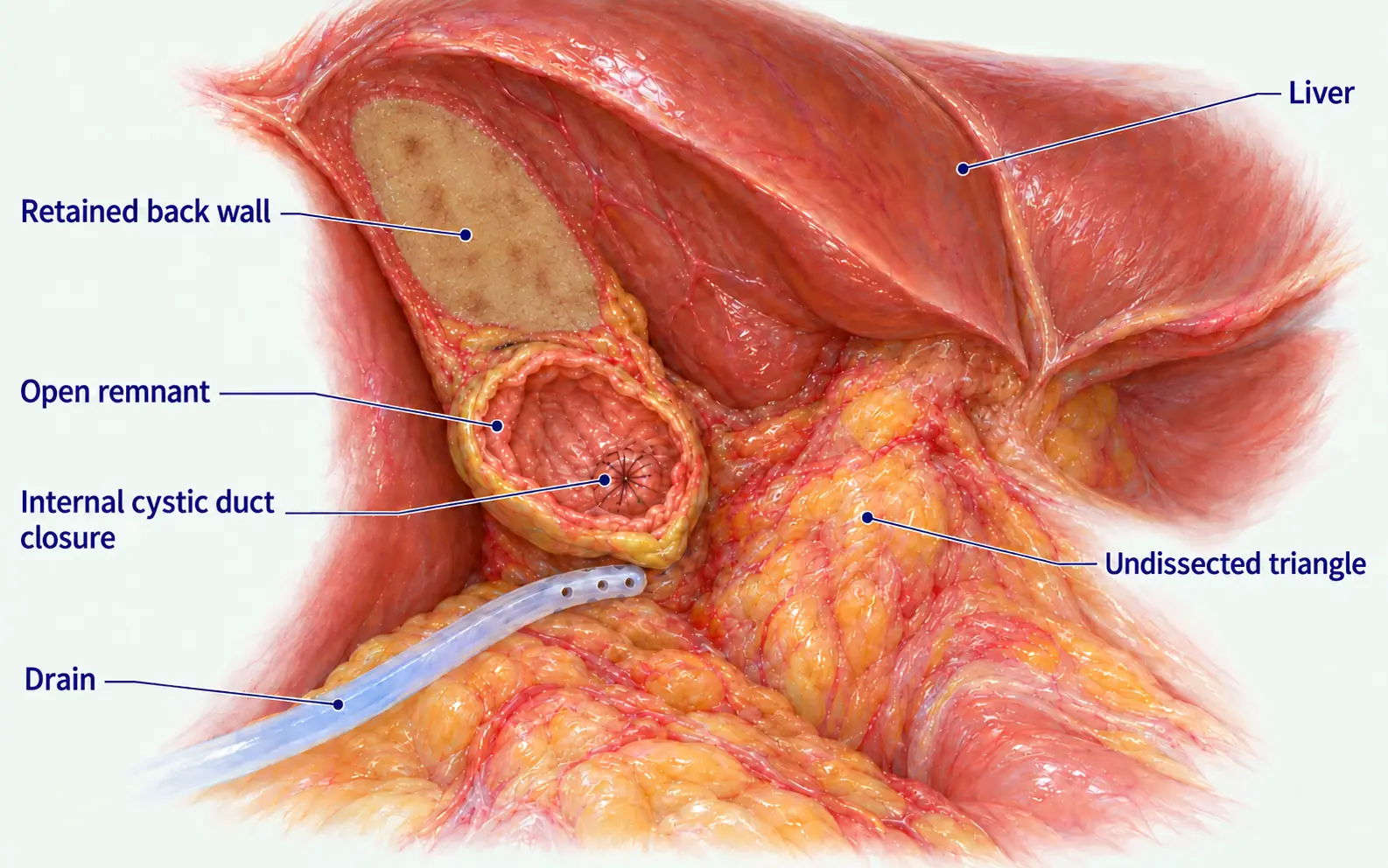
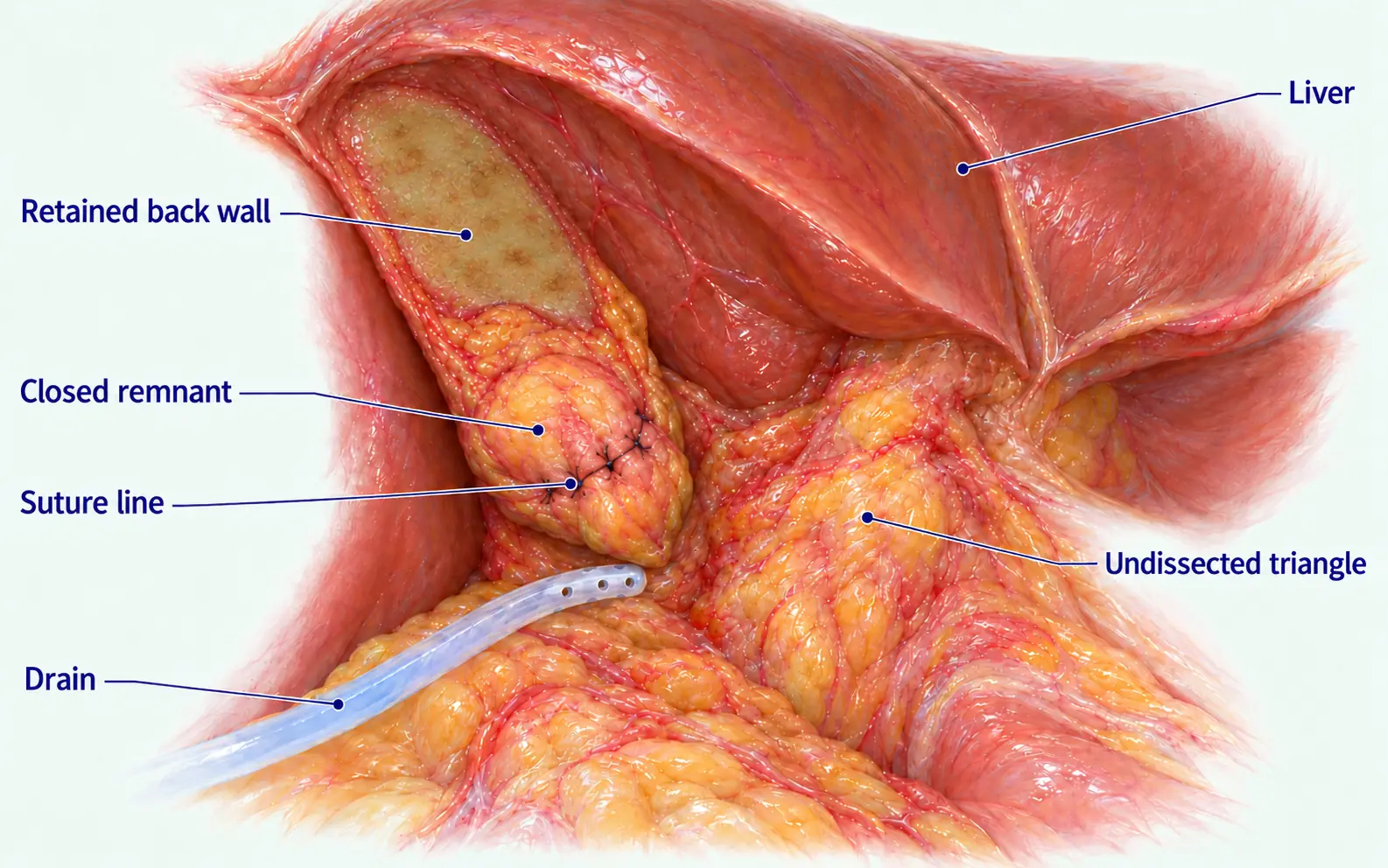
Image source and reuse
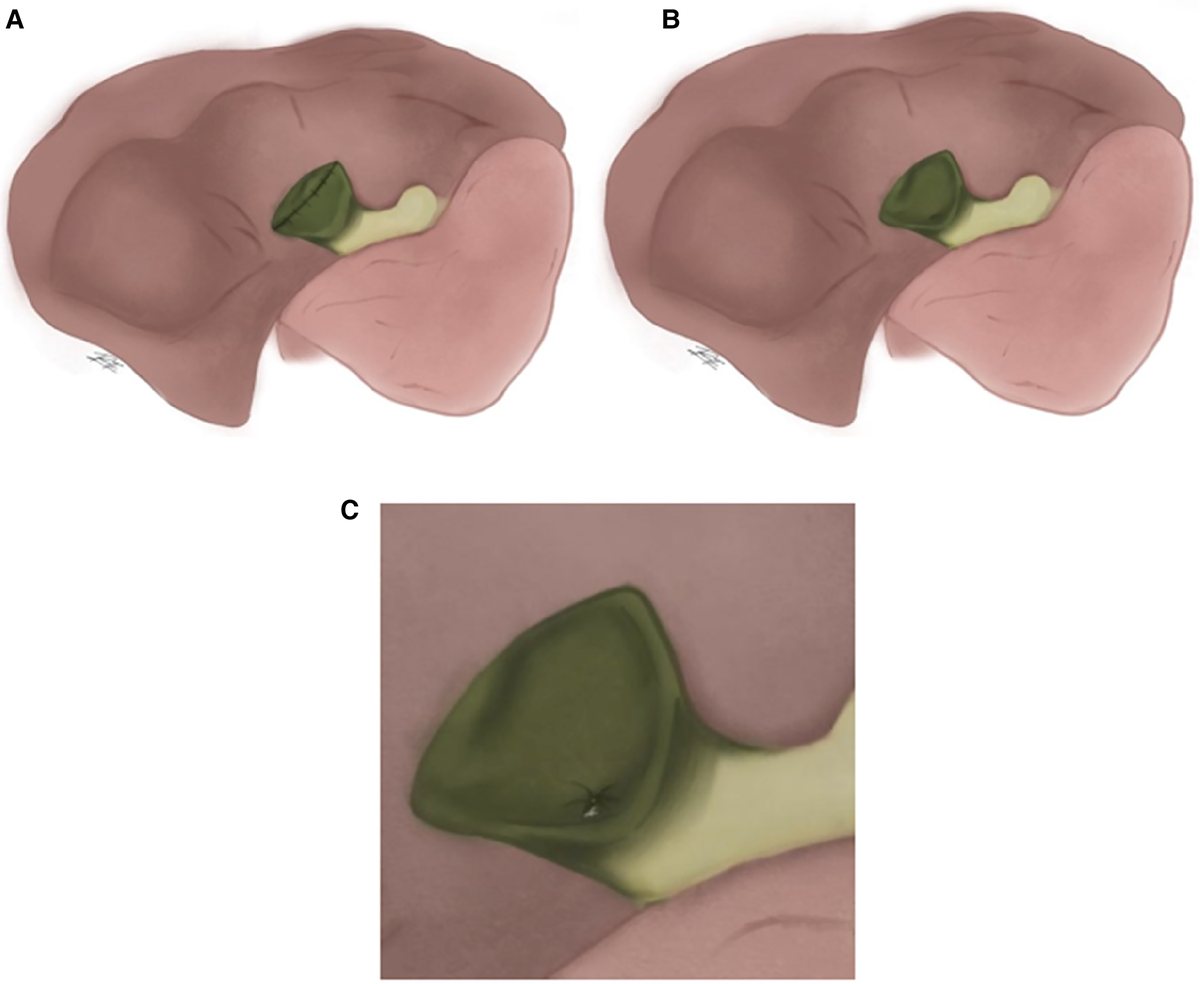
Image source and reuse
Technique (laparoscopic)
- Decide early. A subtotal chosen at 30 minutes is a different operation from one chosen after two hours of bleeding.
- Open the gallbladder at the fundus or body, away from the neck. Suck out bile and pus; bag every stone you can; send fluid for culture.
- Inspect the inside. Find the cystic duct orifice at the lowest point of the neck. Remove an impacted stone if it comes easily; leave it if not. Look for an opening that is too large (a Mirizzi fistula).
- Excise the anterior and free wall, leaving a 5 to 10 mm cuff around the neck and the whole posterior wall on the liver.
- Ablate the remaining mucosa with diathermy or argon beam.
- Close, only if it is safe: purse-string the orifice from inside when the true opening can be seen and reached (fenestrating), or run a suture or stapler across healthy, non-fibrotic neck tissue (reconstituting). Keep diathermy and needles away from the main duct. If neither is safe, leave the orifice open and drain. No clips on a fibrotic thick neck: they slip.
- Drain near the remnant. Record exactly what was done, with a drawing, and tell the patient.
Handover and follow-up after a subtotal
- Write it down: which type, whether the orifice was closed, stones left behind, and the drain plan; tell the patient and the ward in the same words.
- Drain: bile that persists beyond a few days or rises in volume is reviewed with liver tests and ultrasound; most leaks settle with a drain, some need ERCP and a stent.
- Retained stones: liver tests and ultrasound at follow-up; MRCP or ERCP for pain, jaundice or cholangitis.
- Histology of the free wall is sent and chased.
- Remnant disease: recurrent biliary symptoms, more often after a reconstituting subtotal, may need a completion cholecystectomy by an experienced team; refer early rather than repeat the same operation. Expert opinion
Fenestrating versus reconstituting
| Fenestrating | Reconstituting | |
|---|---|---|
| Early bile leak | About 1 in 5; most close with a drain, some need endoscopic retrograde cholangiopancreatography (ERCP) and a stent | Around 1 in 15 |
| Late symptoms, remnant or duct stones | Less common, not rare: retained stones in about 5 to 7 percent and reoperation in 1 to 4 percent in the 2021 meta-analyses; recurrent biliary disease 9 percent at a median 6 years in one series | Higher over the years: recurrent biliary disease 18 percent at 6 years in the same series; some need a difficult completion cholecystectomy |
| Bile duct injury | Very rare | Very rare |
| Technical demand | Lower: a purse-string from inside if the orifice can be seen, or nothing | Higher: secure laparoscopic closure of inflamed tissue |
| Where it fits | Severe inflammation, an unidentifiable neck, limited time, easy ERCP access | A neck that closes on healthy tissue; a patient who would tolerate a leak badly; no ready ERCP |
Fenestrating
- Early bile leak
- About 1 in 5; most close with a drain, some need endoscopic retrograde cholangiopancreatography (ERCP) and a stent
- Late symptoms, remnant or duct stones
- Less common, not rare: retained stones in about 5 to 7 percent and reoperation in 1 to 4 percent in the 2021 meta-analyses; recurrent biliary disease 9 percent at a median 6 years in one series
- Bile duct injury
- Very rare
- Technical demand
- Lower: a purse-string from inside if the orifice can be seen, or nothing
- Where it fits
- Severe inflammation, an unidentifiable neck, limited time, easy ERCP access
Reconstituting
- Early bile leak
- Around 1 in 15
- Late symptoms, remnant or duct stones
- Higher over the years: recurrent biliary disease 18 percent at 6 years in the same series; some need a difficult completion cholecystectomy
- Bile duct injury
- Very rare
- Technical demand
- Higher: secure laparoscopic closure of inflamed tissue
- Where it fits
- A neck that closes on healthy tissue; a patient who would tolerate a leak badly; no ready ERCP
Contested Choose the subtotal technique that can be completed safely. Reconstituting requires tissue that will hold a secure closure; fenestrating remains an option when closure is unsafe, with a plan for drainage and possible ERCP. Discuss leak and recurrent biliary symptoms with the patient. The 2020 consensus does not favour either subtype; the comparisons below are predominantly observational. Expert opinion
More detail and sources
Definitions: Strasberg et al., J Am Coll Surg 2016. Pooling 13 studies with 985 patients, Motter and colleagues found bile leak less common after reconstituting subtotal cholecystectomy (odds ratio 0.29, 95 percent confidence interval 0.16 to 0.55) and post-operative ERCP less common in sensitivity analysis, with no significant differences in reoperation, readmission, completion cholecystectomy or retained duct stones (Motter et al., Surg Endosc 2024). A 2026 meta-analysis of 13 observational studies reached the same bile-leak estimate (odds ratio 0.29) with ERCP and reoperation not significantly different (Makhsosi et al., BMC Surg 2026). A prospective study of 369 subtotal cholecystectomies in 11 American hospitals found bile leaks in 22 percent of fenestrating versus 7 percent of reconstituting operations, retained duct stones in 4 percent versus 14 percent, and more interventional radiology and ERCP procedures after fenestrating; 40 percent of the early ERCPs found nothing to treat (Johnson et al., J Am Coll Surg 2026). Earlier systematic reviews reported a bile leak rate around 18 percent after subtotal cholecystectomy overall, mostly managed with drains and ERCP, with reoperation under 2 percent and bile duct injury well under 1 percent (Elshaer et al., JAMA Surg 2015).
The trade-off in numbers. The 2023 overview by Ramírez-Giraldo et al., Front Surg 2023 summarises the 2021 meta-analyses: retained stones in 4.8 to 6.7 percent after fenestrating against 2.5 to 4.2 percent after reconstituting (Nzenwa; Koo), reoperation 3.5 versus 1.3 percent (Koo), and bile leak consistently higher after fenestrating. Over a median 6 years, van Dijk and colleagues found recurrent biliary disease in 9 percent after fenestrating and 18 percent after reconstituting. All of it is observational, and the figures are taken from that overview rather than from each primary paper. Systematic review Observational
Long term. A ten-year single-institution series with patient-reported outcomes found most patients symptom-free, a minority with recurrent biliary symptoms, and completion cholecystectomy needed in a small proportion, more often after reconstituting operations (Surgery 2024). Subtotal cholecystectomy is not a cure in every patient, but it is a safe operation in the only situation in which it is used.
05Conversion to open surgery
- Conversion is one bail-out option when it adds safety. A triangle that cannot be dissected laparoscopically is no safer with a hand in it, and Strasberg’s extreme injuries happened mostly after conversion.
- Convert when safe laparoscopic control or progress is not possible and open access can help. Reassess the anatomy after conversion; an open subtotal or stopping may still be needed.
- Once open, the same rules apply: identify by exclusion, stay on the gallbladder, do an open subtotal if the triangle is unsafe.
Convert for a reason the open approach solves: bleeding uncontrolled after pressure, suction and a second surgeon; a recognised duct injury to be repaired or drained open by someone competent; adhesions preventing any access, or a fistula needing bowel resection; inability to tolerate pneumoperitoneum.
Source
The 2020 multi-society guideline (Q12) made no recommendation on conversion to reduce BDI because comparative evidence was insufficient. The WSES BDI guideline, 2021 (1.3) allows conversion when the operator cannot manage the procedure laparoscopically (weak recommendation, moderate-quality evidence), but does not establish BDI reduction. The WSES acute cholecystitis guideline, 2020 (3.5) strongly recommends conversion for severe local inflammation, adhesions, bleeding from Calot’s triangle or suspected BDI. Guideline
06Cholecystostomy and abandoning the operation
The septic, frozen gallbladder
When neither total nor subtotal cholecystectomy is safe (a frozen, bleeding field in an unstable patient; a surgeon without the experience for a subtotal), end the sepsis and end the risk. Decompress an empyema or a tense gallbladder with a tube cholecystostomy (often a Foley through the fundus). Leave a subhepatic drain when there is bile, pus or bleeding to drain, not by reflex. Close, give antibiotics, tell the patient and family, and refer to a hepatobiliary unit.
An unfinished operation with an intact bile duct is a good result. A finished operation with a divided bile duct is the worst result in benign surgery
Suspected cancer: a different pathway
A hard, irregular or fixed gallbladder, a mass, liver invasion or suspicious nodes is not a bail-out problem. Keep the gallbladder intact: do not open it, do not do a subtotal or a cholecystostomy through it, and avoid perforation and bile spillage, which seed the peritoneum and the ports. Photograph the findings, take a biopsy only if it will change the next step and will not spill, and get hepatobiliary advice, from theatre if possible. If the gallbladder is already free and intact, finish, bag it and send it; otherwise close and refer for staging. Place a drain only for a clinical reason such as bleeding or bile.
Sources
Careful handling to avoid bile spillage is the basis for laparoscopic surgery in gallbladder cancer (Han et al., Laparoscopic surgery for gallbladder cancer: an expert consensus statement, Dig Surg 2019; checked against the abstract only). Spillage and operative perforation raise concern for tumour dissemination and must be documented; they do not automatically change TNM stage, and an unplanned radical resection without imaging, consent and expertise is not recommended (see the sources on gallbladder cancer). Expert opinion Drain use after cholecystectomy: routine drainage is not supported in uncomplicated surgery (Gurusamy et al., Cochrane 2013). Systematic review
- Do not clip “the only duct you can see” to get out.
- Do not use diathermy to find a plane in the triangle.
- Do not attempt to repair a suspected duct injury unless you are a hepatobiliary surgeon: drain and refer (bile duct injury).
- Do not convert to “have a feel”; convert for bleeding or access.
- Do not persist because the list is late, the patient is young, or you have never done a subtotal. The last is a reason to learn one before you need one.
- I can’t get the critical view of safety… now what?Michael Pucci, SAGES 2018, about 14 minutes. Predicting difficulty, when to bail out, subtotal and fenestrating techniques.
- Exit strategies for the difficult gallbladderMichael Pucci, SAGES 2017, about 18 minutes. When and how to convert, and open subtotal cholecystectomy.
Links checked 25 October 2026. The videos are hosted by SAGES; the site may ask you to sign in.
07What examiners ask
- List the bail-out options and explain how the anatomy, patient and available expertise determine the choice.
- Define fenestrating and reconstituting subtotal cholecystectomy and give the trade-off in one sentence each.
- Why fundus-first dissection is dangerous in severe inflammation.
- When conversion to open adds safety, and why it does not itself resolve unclear anatomy.
- How you manage the leak after a fenestrating subtotal: ensure drainage, observe only while improving, and arrange ERCP for persistent/high-output leakage or earlier if there is no improvement or deterioration (complications).
Test yourself further: Practise questions on Bail-out strategies in the Exam zone.